Return of the Lord and Resurrection of the Dead? Or Something Else?
by Daniel Botkins
Followers of Jesus (Yeshua) who have studied the seven annual Feasts of the LORD in Leviticus 23 are familiar with the prophetic significance of these seven Feasts. The four spring Feasts point to events that happened during the First Coming of the Messiah. Therefore it makes sense that the three fall Feasts point to events that will happen during the Second Coming of the Messiah. Without going into all the details, here is a brief general outline of what is commonly taught.
THE SPRING FEASTS
The four spring Feasts prophetically point to Messiah’s First Coming, as follows:
1. Passover points to Messiah’s death as the Lamb of God, “for Christ our Passover is sacrificed for us” (1 Cor. 5:7).
2. Unleavened Bread points to Messiah’s burial in anticipation of His Resurrection, like “bread which comes forth from the earth” (Traditional Jewish blessing for bread).
3. First Fruits points to Messiah’s Resurrection as “Christ the first fruits of them that slept [i.e., died]” (1 Cor. 15:20).
4. Pentecost, the anniversary of the giving of the law, points to the coming of the Holy Spirit, when the law was “written not with ink, but with the Spirit of the living God; not in tables of stone, but in fleshly tables of the heart” (2 Cor. 3:3).
THE FALL FEASTS
It is believed that the three fall Feasts prophetically point to Messiah’s Second Coming, as follows:
1. Trumpets points to Messiah’s Return, when a trumpet sounds and “the dead in Christ shall rise” (1 Thes. 4:16).
2. Yom Kippur, the Day of Atonement, points to Israel’s redemption, when “they shall look upon Me whom they have pierced, and they shall mourn for him” and “all Israel shall be saved” (Zech. 12:10 & Rom. 11:26).
3. Sukkot, the Feast of Tabernacles, points to the Messianic Kingdom, when all the nations shall go up to Jerusalem “to keep the feast of tabernacles” (Zech. 14:16).
The prophetic significance of the four spring Feasts is easy to see, because the historic Messianic events to which those four Feasts pointed have already happened. Messiah died as the Lamb of God on Passover. He was buried on Unleavened Bread. He rose from the dead as the first fruits of the resurrection on First Fruits. The Holy Spirit came to write the law on the hearts of God’s people on the day of Pentecost.
Because each of those four events happened on the corresponding feast days that pointed to each event, it is expected that the same thing will happen when the three fall Feasts are fulfilled. It is expected that Messiah will return on the Day of Trumpets, that He will reveal Himself as Messiah to the Jews on the Day of Atonement, and that He will set up His kingdom and start reigning on the Feast of Tabernacles.
That is the way that most people expect the events to unfold at the Second Coming. However, it is possible that the events might unfold in a slightly different way. Last September on the Day of Trumpets, Arthur Cox, the pastor of our local assembly, presented a different possibility. The more I ponder this possibility, the more feasible it seems. Therefore I want to share with you what Art said about the Day of Trumpets and its possible prophetic significance, and add some thoughts of my own.
The reason most people expect the Lord to return on the Day of Trumpets is because three passages of Scripture mention trumpets in connection to the Return of the Lord:
l “In a moment, in the twinkling of an eye, at the last trump: for the trumpet shall sound, and the dead shall be raised incorruptible, and we shall be changed” (1 Cor. 15:52).
l “For the Lord Himself shall descend from heaven with a shout, with the voice of the archangel, and with the trump of God: and the dead in Christ shall rise first” (1 Thes. 4:16).
l “And the seventh angel sounded; and there were great voices in heaven, saying, The kingdoms of this world are become the kingdoms of our Lord, and of His Christ; and He shall reign for ever and ever” (Rev. 11:15). (The word “trumpet” is not mentioned in this verse, but Revelation 8:6 says that the seven angels “prepared themselves to sound” with “trumpets.” Therefore the “sound” in this verse is the sound of a trumpet.)
It is assumed that the mention of trumpets in these three passages means that the Day of Trumpets, the first day of the seventh month, is the day the Lord will return. That seems to make sense, but there are two problems with this assumption.
NO MAN KNOWS THE HOUR OR THE DAY
The first problem is that Yeshua said no man knows the hour or the day of His Return. (See Matthew 24:36 & Luke 13:32.) If we say that Yeshua will return on the Day of Trumpets, then we are saying that we do know the day of His Return. It will be on Tishrei 1, the first day of the seventh month.
“But Daniel, we don’t know which year it will happen.”
I understand. But you are still saying that you know the day. The day is Yom Teruah, the Day of Trumpets, Tishrei 1. You are saying that you do not know the year, but Yeshua did not say “no man knows the year.” He said that no man knows the day.
“But Daniel, the first day of the lunar month is determined by the new moon. Cloudy weather might hide the new moon for a day or longer, so we don’t really know the exact day.”
Again, I understand. But even if the new moon is unable to be seen because of cloudy weather, the new moon is still there. Furthermore, in Bible times people did not need to see the new moon to know which day would be new moon. Jonathan said to David, “Tomorrow is the new moon” (1 Sam. 20:18), i.e., the first day of the month.
Jonathan and David knew which day would be the first day of the month, and Jews today know which day will be the first day of the month, in spite of all the “reconstructed, corrected, and restored” calendars put together by lone, independent Messianic mavericks.
THE LAST TRUMPET
The second problem with the assumption that the Lord will return on the Day of Trumpets is the fact that 1 Corinthians 15:52 says that the resurrection of the dead will occur “at the last trump.” The Day of Trumpets is not the only time when the blowing of trumpets is commanded. There are other sabbaths and trumpets besides those listed in Leviticus 23. In Leviticus chapter 25 there is a commandment to let the land rest every seventh year, called the shmittah year. Then after seven consecutive land sabbaths (49 years), a trumpet is sounded to announce the Year of Jubilee in the 50th year. This trumpet is sounded on Yom Kippur, the Day of Atonement, on the tenth day of the seventh month, nine days after the Day of Trumpets. (See Leviticus 25:1-9.)
In the Year of Jubilee, slaves are freed, debts are canceled, and the land reverts back to its owners. The Bible does not clearly state that the Messiah will return in a Jubilee year, but that is what many people expect. We even sing about it in songs like Awake, O Israel: “For out of Zion comes your Redeemer in the Year of Jubilee!”
If the Lord returns in a Jubilee year, “the last trumpet” on that year will not be sounded on Tishrei 1, the Day of Trumpets. It will be sounded nine days later, on the Day of Atonement, as it is written, “Then shalt thou cause the trumpet of the jubilee to sound on the tenth day of the seventh month, in the day of atonement shall ye make the trumpet sound throughout all your land” (Lev. 25:9).
This information suggests that maybe the Return of the Lord will be on the Day of Atonement in a Jubilee year rather than on the Day of Trumpets. If that is the case (and I am not saying that it is), then what prophetic event would the Day of Trumpets be pointing to?
ROSH HASHANAH:
A WAKE-UP CALL TO REPENTANCE
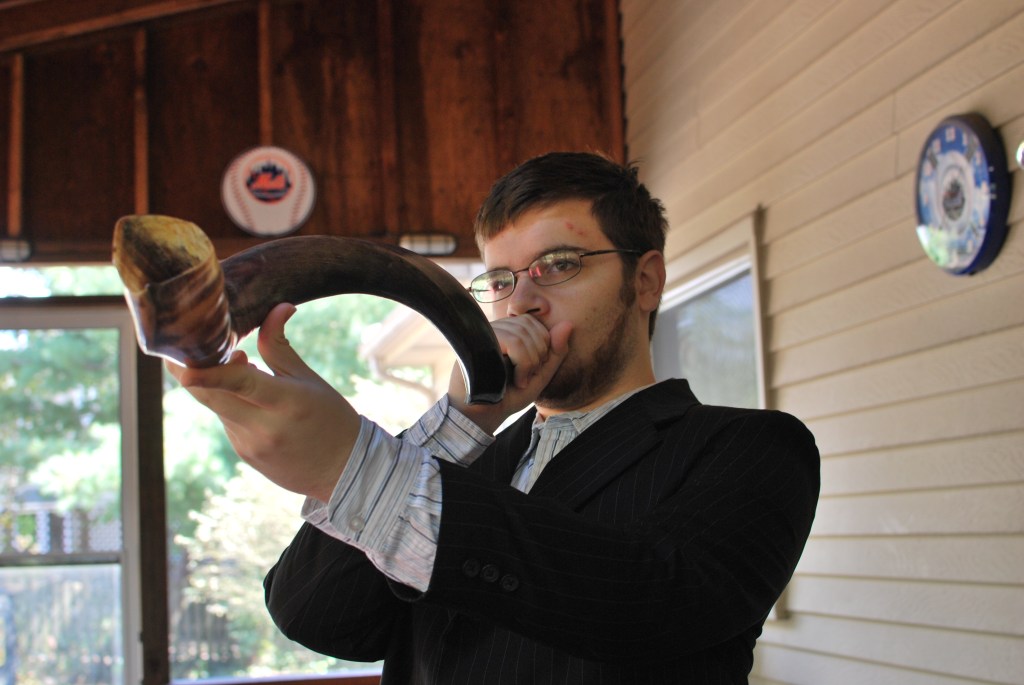
The blowing of the shofar on the Day of Trumpets (also known as Rosh HaShanah) is understood by Jews as a wake-up call to repent of their sins, in preparation for the Day of Atonement, which is viewed as Judgment Day, when it will be determined who will live and who will die in the coming year. The days between Rosh HaShanah and Yom Kippur are called yamim ha-nora’im, “the days of awe,” when repentance intensifies, culminating on Yom Kippur. With that thought in mind, the events might unfold as follows in the year when the Messiah returns:
That year when the shofars are sounding on Rosh HaShanah, the Jewish people as a whole sincerely repent of their sins, including their sin of rejecting Yeshua. There is nation-wide repentance during the yamim ha-nora’im, and it culminates on Yom Kippur when they “look upon [the Messiah] whom they have pierced” and “mourn for Him, as one mourneth for his only son, and shall be in bitterness for Him, as one that is in bitterness for his firstborn” (Zech. 12:10). Thus they finally find full atonement on the Day of Atonement. If that year happens to be a Jubilee Year, then “the last trumpet” will be sounded on Yom Kippur, and the Lord will return and raise the dead.
Or, maybe the Lord will not return on that Day of Atonement, but sometime during the four days between Yom Kippur and Sukkot, the Feast of Tabernacles. After all, the Lord does not need to have an earthly trumpet sounding when the heavenly trumpet sounds to announce His arrival. If He wanted, He could come on any day between Yom Kippur and Sukkot, and take the throne of the Messianic Kingdom on the first day of Sukkot.
So if some year on Rosh HaShanah you see nation-wide repentance among Jews in Israel, and you hear rabbis publicly announcing that their forefathers made a tragic mistake, and they call on the entire nation to repent for their rejection of Yeshua — if you see that happening, then get ready, because in Matthew 23:39 Yeshua said to Jerusalem, “Ye shall not see Me henceforth, till ye shall say, Blessed is he that cometh in the name of the Lord.” The phrase “blessed is he that comes,” baruch ha-ba, is how you say “Welcome” in Hebrew. When the Jewish leaders in Jerusalem are ready to welcome Yeshua as their Messiah, He will be ready to come back home.
The possibility of the Lord returning on Yom Kippur or on one of the days between Yom Kippur and Sukkot results in no man knowing the day of His Return. If some year we see Jewish leaders in Israel calling on the nation to repent for their rejection of Yeshua, as described in the above paragraph, then we can be pretty sure that Yeshua will return that year, either on Yom Kippur or on the days between Yom Kippur and Sukkot.
We will know the year but not the day, rather than claiming that we know the day but not the year.
Also consider Hosea 5:15-6:2, where the Lord speaks of His departure from the people of Israel, followed by His return when the people repent, keeping in mind that “One day is with the Lord as a thousand years” (2 Pet. 3:8):
“I will go and return to My place [Yeshua’s return to heaven; the Ascension], till they acknowledge their offence [their rejection of Yeshua], and seek My face: in their affliction [great tribulation] they will seek Me early” (Hos. 5:15).
These words are immediately followed by what the people say as they urge one another to repent of the offence that caused the Lord to depart from them:
“Come, and let us return to the LORD: for He hath torn, and He will heal us; He hath smitten, and He will bind us up. After two days [two millennial days, i.e., 2,000 years of rejecting Messiah?] will He revive us: in the third day [the Millennium?] He will raise us up [resurrection of the dead?], and we shall live in His sight” (Hos. 6:1f).
“One day is with the Lord as a thousand years.” Sometime around the year AD 2033, it will be 2,000 years, two millennial “days,” since the Lord ascended to heaven, where He will remain until the Jewish people say to Him, “Baruch ha-ba, Welcome.” Then He will return, the dead will be raised, and we shall live in His sight on the third “day,” the Millennium.
I am not a date setter and I am not saying that this is definitely the way things will unfold on the year of Yeshua’s Return. I am not super-dogmatic about the details of end-time prophecy, and neither is Arthur Cox. I have a wait-and-see approach to future events. I just wanted to present this as another option for readers to consider.
Regardless of how the events unfold, the Return of the Lord is our “blessed hope” and we will rejoice when He returns.
“Amen. Even so, come Lord Yeshua. The grace of our Lord Yeshua Messiah be with you all. Amen” (Rev. 22:20f). q
( This article was written by Daniel Botkins but inspired by Art Cox’s teaching. This was published in the Gates of Eden bimonthly july/aug. 2024)
 Superwebsite