This paper will deal with a hot topic among Messianic-Hebrew Root Believers: when the beginning of every new Hebrew month occurs.
I will deal with the two most prominently practiced doctrines here and with no others. Why? Because “in the first place, the Jews were entrusted with the very words of Elohim” (Romans 3:2) And because they were entrusted with the safekeeping of the Tanakh AND the priesthood, only they had the authority to determine the calendar system for Israel and her gerim (proselytes).
The problem has become that the Jewish rabbis have practiced two different methods in all of history: first they did Rosh Chodesh when they sighted the first sliver of moon after being dark for 2 or 3 days and then they chose to make Rosh Chodesh day before they saw the first sliver appear. These are the only two methods they have ever done and for some goyim to say that it is on the Full moon or the Lunar Sabbath is not even valid. They never practiced such things NOR did they ever give over their authority to anyone else NOR did Yeshua give a new calendar system when he was incarnate nor after he was resurrected. Hence, I am dealing with only the sighted moon vs. dark moon method.
Sighted Moon method
I am familiar with the Sighted Moon interpretation. With this method, there are only two strong biblical bases for this practice.
- Ber. 1:14 says, “Let there be lights in…the sky… let them be for signs, seasons, days and years.” In this passage, one will say that Light only determines when a day is. They will say that Yah rules the Day and ha-Satan, the night. Pretty simple…
- The other is historical basis. Up to when the Jews were kicked out of eretz Yisrael the second time in 135 AD, they used to practice blowing the shofar from the Land when they saw the first sliver of moon as it was waxing.
Dark Moon method
For the first 10 years I was Messianic, I admit to practicing both these methods, depending on where I fellowshipped. In those days, Messianic Jews allowed non-Jews to worship with them but when the gentiles pointed out that northern Israel hasn’t returned to Yehudah and that they haven’t fulfilled the prophecies related to Efrayim or northern Israel, they started kicking us out of their synagogues and caused the first major division in the Body since YHVH resurrected our faith in the 1960’s. (for more on that subject, I have made clear the heresy of the Messianic Jews in my book “A Latter Day Testament, book 1” which is under the Messianic corner of this website)
For this method, there are really only two biblical bases for this practice also:
- Ber. 1:14 is also an apologetic verse for the Dark Moon observers. The sighted moon observers think this passage is their domain but it is not. The Dark Moon observers rely on the light of the sun and the moon to determine their seasons, days and years also. It is called the Solar-Lunar calendar.
- The second basis is historical also: when the Jews were kicked out of the Land, it didn’t take long before they realized that the Diaspora Jews would not be united in their worship if they couldn’t declare the beginning of the month from the Land. Therefore, Rabbi Hillel the 2nd devised a perpetual calendar of sorts where the Jews could know when to keep the holy days and Rosh Chodesh, by extension. The day of the dark moon replaced the sighted moon in most months.
New Evidence
On the last note, it would appear that the Sighted Moon observers have a slight edge over Dark Moon observers in terms of justification but I, the author, am bringing forth new evidence that gives more weight to the Dark Moon observers because when I became Messianic, the first 10 years of my halakha (walk), I practiced both methods sincerely until Passover one year, when I observed the moon and made a discovery that would convict from that time forward. That observation has been confirmed over and over, every year, and then some! I now bring forth, two new reasons why Rosh Chodesh is on the Dark Moon every month, to add to the above.
One – more accurate timepiece
The first defence I give is that the Dark Moon method is a more accurate timepiece of the moedim than the sighted Moon.
When there is a prophetic utterance given in Israel, and there is controversy as to whether the Lord said it, what is the protocol in Israel? You all know: I don’t have to say it. Many times in the Tanakh, after the Urim and Tumim were lost to history, kings and priests would ask the Lord to confirm the first word. There are too many passages to list here and I would summarize by saying that even Paul used this protocol in worship: 1 Cor.14:13&27. Paul was basically asking for someone to confirm what a person speaking in tongues was saying.
There should be NO division in the Body of Messiah but of course, Messianic-Hebrew Roots goyim excel at what they should not!
In this case, the 1st day of Rosh Chodesh is in controversy. Both sides have legitimate bases but this is a rare case where BOTH cannot be right.
In this case, rather than argue about what defines the beginning of the month, let us find something in which we can agree, that will point back to the New Moon because if we can all can agree on a common basis, then we can deduce from our common fact and go from there.
We can ALL agree as to when the full moon is. And since we do, we ALL know that the full moon, which can only fall on one day per month, is evidence of the middle of the lunar cycle. The moon can’t wax any bigger or fuller after it has become “full” therefore it begins waning after it has become full. In fact, there are some months where the Lord brings the moon closer to the earth so that we can see it is full. (of course, Science has explained that the moon isn’t closer but that it is an optical illusion) This is all very elementary even to non-moon observers.
So far, the first day is in controversy; the full moon is not and we know that the full moon always occurs in the middle of the lunar cycle which is 29 ½ days which means the full moon occurs approximately in the middle of the 14th day of the month. Since the middle of the 14th day of the month is daytime, we have to wait until the end of the 14th to see the full moon.
To those who keep the moedim (appointed times/festivals) of the Lord, what happens on the 15th day of the month 2x a year? A high Sabbath! There is a verse that ties together these two moedim and Rosh Chodesh that our household customarily reads every Rosh Chodesh:
“Sound the shofar at Rosh Chodesh and at full moon for the pilgrim feast, because this is a law for Israel…” Tehillim/ Ps. 81:4-5a
Many Messianics blow the shofar on Rosh Chodesh but the Sighted Moon observers fail to see their error every month because if you are blowing the shofar on the 1st day of Unleavening or the 1st day of Sukkot and the moon is not perfectly full, you are too late in blowing the shofar! The moon can’t be 97 or 98% full to be the full moon but it must be 100% round in order to be the full moon. Furthermore, when you see the full moon, you know that you know that it is exactly two weeks since Rosh Chodesh. I have been observing the moon and this common sense fact ever since I discovered that the Sighted Moon observers are always a day or two off in the rest of their cycle. A waxing quarter moon is the end of the first week; the full moon is the end of the second week; the waning quarter moon is the end of the 3rd week. The “Sighted” Moon observers are never in line with the phase of the moon. The Moon phases, especially the full Moon, are confirmations of which day was Rosh Chodesh. The Sighted Moon observers are usually starting their festival when the Moon has already started to wane. You can’t see that every month but if ya’ll start observing the Moon all month long, you will see that when the moon is full, full moon day, Rosh Chodesh was 15 days before that, which is always at the Dark Moon or zero degrees in its cycle.
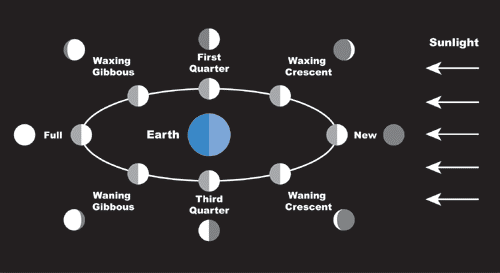
Lunar phases. Image: NASA.
Two – it is in alignment with the biblical day
Most Messianic Believers would agree the biblical day begins at sunset and ends at sunset the next day in comparison to the roman Gregorian calendar we have today. And where do we get this evidence from? We get it of course from the Creation Week when Elohim said “there was evening and there was morning” six times over in Beresheit 1 and again for Yom Kippur in Vayikra 23 when he said to keep the fast day “from evening of the ninth day of the month until the following evening” (Vay.23:32) We have a double witness so it is well established…
It is well established and evident to almost everyone in the Body of Messiah except those who advocate a biblical day runs from morning to morning. There is a scripture they have that seems to lend credence to a morning-to-morning day but I have forgotten it because even though it seems to sound like a truth, the weight of biblical evidence clearly sides with the evening-to-evening reckoning.
Nevertheless, brethren are not careful to what and where they learn Bible. The same people above who advocate a morning-to-morning system justify this doctrine by pointing out that the Romans changed the day to begin and end at midnight (and their system has been imposed on us to this day) and that this was a stupid reckoning of time because there is no reference one can use to determine which hour of the night it is under this system, much less determining when a day begins because the sun isn’t out! We, all, agree on that point but it doesn’t occur to the Sighted Moon Believers that they are borrowing the same logic from Hebrew Israelites (a.k.a. Black Jews) and Lunar Sabbatarians, 2 sects riddled with biblical errors, to justify their reckoning of the new month! How so? I have heard almost all Sighted Moon people say that one can’t begin a month in the dark phase of the Moon because the moon is dark 1,2 or even 3 nights a month! It sounds logical because we all agree that the Roman reckoning is wrong but the Sighted Moon people fail to apply their logic to the reckoning of a biblical Day. If a New Moon can’t begin in the dark phase, then ALL Sighted Moon observers should be practicing a biblical day from morning-to-morning! There is no chapter and verse in the Bible that says “when you see the sliver of the Moon, you will reckon it as the first day of the month”. Anyone of that system who is honest will agree and will have to agree that seeing the sliver of the Moon for Rosh Chodesh is just an interpretation of what the Bible fails to define.
Conclusion
After all is said on this subject, not only does the weight of evidence tilt to the side of Dark Moon observers but the very definition of when Rosh Chodesh is, aligns perfectly with the biblical day: the biblical day begins when the sun sets and the beginning of the new month begins when you don’t see the moon anymore after waning.
As acknowledged already: yes, the Moon is “hidden” for up to 2 days, or even 3 on rare occasions but we can still know when the New Moon is because the Bible also created a principle of what we call Proclaiming and Confirming. Whenever something is proclaimed (and all the moedim fall under this principle as stated by Daniel Botkins in one issue of GOE) from Heaven, there is always confirmation of that Proclamation. In this case, the Full Moon is confirmation of the New Moon because it will always be 15 days after the New Moon. Sighted Moon observers: start counting the days backward from the full moon for as long as I have and you will “know that you know” what the truth is on this subject….
 Superwebsite